








Low-Temperature Industrial Refrigeration
Choosing the Most Efficient Natural Refrigerant Solution
Natural Refrigeration Systems for Applications Down to -45°C
Many industrial processes require extremely low evaporation temperatures, often around -45°C, to ensure product quality, safety, and operational continuity. Typical applications include IQF (Individual Quick Freezing) tunnels, spiral freezers, blast freezers and freezing tunnels, fish and seafood processing, freeze-drying systems, and numerous food industry processes.
In these applications, the choice of refrigeration technology impacts not only the system’s energy efficiency but also the total cost of ownership (TCO), sustainability performance, and compliance with future regulations.
The Only Partner with Expertise Across All Natural Refrigerant Technologies
Enex Technologies is the only climate-tech company able to offer a comprehensive HVAC&R portfolio based exclusively on natural refrigerants:
Ammonia (R717)
CO2 (R744)
Propane (R290)
Water (R718)
Isobutane (R600a)
This broad expertise enables the selection of the most suitable technology for each application, without the limitations associated with a single refrigeration platform.
Main Configurations for Low-Temperature Industrial Refrigeration
CO2 Booster System (R744)
The CO2 booster configuration often represents the solution with the lowest initial investment (CAPEX).

Key features:
- Two-stage reciprocating compressors
- Direct expansion system
- Remote air-cooled gas cooler
- Simple and compact layout
This solution is particularly attractive for small and medium-sized installations where minimizing initial investment is a priority.
Ammonia Pumped System (R717)
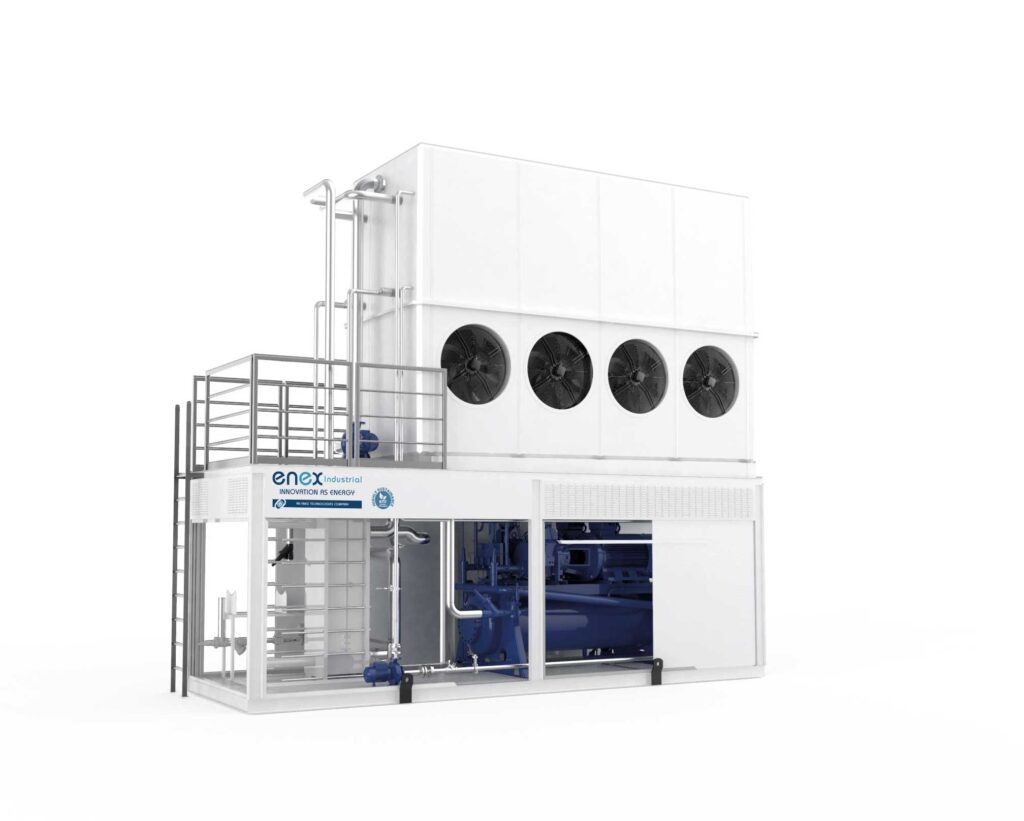
Ammonia remains the benchmark for energy performance across many industrial refrigeration applications.
Key features:
- R717 screw compressors
- Single-stage system with economizer
- Pumping skid
- Evaporative condenser
Simulation results show that the R717 system achieves the highest annual COP values among the technologies analyzed.
R717/R744 Cascade System
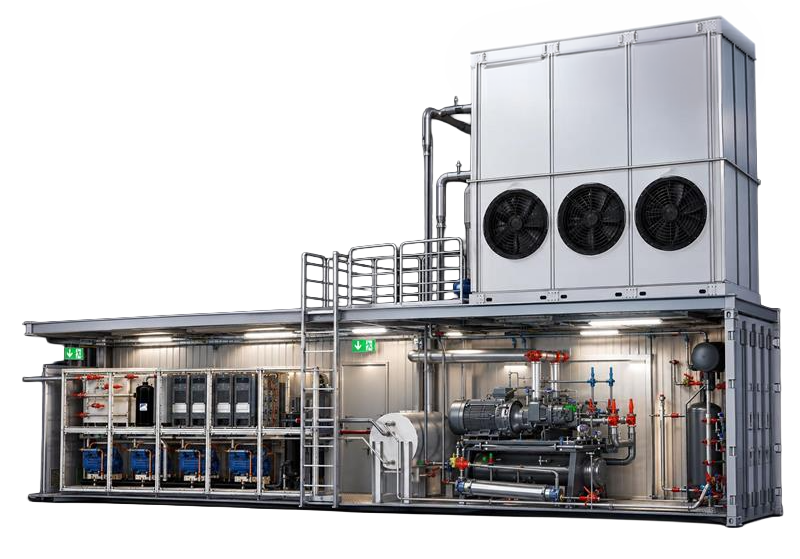
Cascade technology combines the strengths of ammonia and CO2.
Key features:
- R717 screw compressors on the high-pressure side
- R744 reciprocating compressors on the low-temperature side
- Intermediate heat exchanger
- Reduced ammonia charge
Compared to traditional ammonia systems, this configuration significantly reduces the amount of R717 required while maintaining high energy performance.
Investment Cost and Energy Efficiency Comparison
A comparative analysis carried out by Enex Technologies evaluated the three technologies in 150 kW, 300 kW, and 600 kW refrigeration plants, assessing both energy costs and initial investments over a 15-year operating period across multiple European cities.
Key Findings
- Energy Efficiency
- The R717 system achieves the highest annual COP.
- The R717/R744 cascade solution delivers performance very close to ammonia systems, particularly in the warmer climates of Southern Europe.
- CO2 booster system performance is more significantly affected by high ambient temperatures.
Payback Period
The results demonstrate that there is no universally optimal solution.
For smaller-capacity systems, CO2 can be particularly competitive thanks to its lower CAPEX.
As refrigeration capacity increases, ammonia and cascade solutions become increasingly attractive.
In countries characterized by high electricity costs and warmer climates, cascade systems often provide the shortest payback periods.
There Is No One-Size-Fits-All Solution. There Is the Right Solution.
Selecting the most cost-effective refrigeration system depends on several factors:
- Local climate conditions
- Required design temperature
- Refrigeration capacity
- Electricity costs
- Refrigerant charge limitations
- Site safety requirements
- Sustainability and decarbonization objectives
This is why partnering with Enex Technologies provides a strategic advantage. Thanks to its extensive expertise across all major natural refrigerants, including R717, R744, R290, R718, and R600a, the company can identify the best natural refrigerant solution for every application without being tied to a single solution.
This independent approach helps maximize efficiency, sustainability, and return on investment.