








Chapter 2: How physics beat chemistry
Sergio Girotto
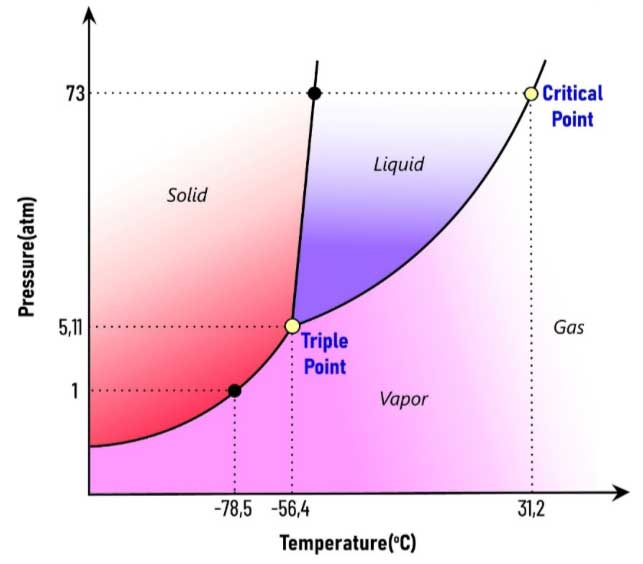
While the chemical empires frantically hunted for a new “magic molecule,” thermodynamics, with its ancient, unbending laws, pointed us toward home. By 1995, research at NIST (conducted by McLinden and Domanski), had sounded the death knell: the atomic combinations for safe, efficient artificial refrigerants were exhausted. The “chemical solution” had surrendered, and it wastime for physics to take the helm. Choosing pure carbon dioxide (R744) meant colliding head-on with a terrifying physical wall: its low critical temperature of 31.1 degrees.
In Trondheim, Professor Lorentzen had drawn the map to bypass this wall. He theorized that above this temperature, CO2 shouldn’t be forced to condense like traditional fluids. Instead, it enters a “transcritical” state, a dense, restless gas.
The energetic yield was a marvel with outstanding heat transfer properties, but the result it birthed was fearsome: it demanded operating pressures of up to 120 bar, compared to the gentle 15-20 bar we were accustomed to.
Phase Diagram of CO2
In 1995, this still was just an elegant poem without a voice, since there were no compressors and no valves capable of holding that pressure. But, as you might know, here in Italy, artisanship is a form of stubborn poetry. From a firm handshake between Costan and Officine Mario Dorin, the world’s first prototype of a semi-hermetic compressor for transcritical CO2 was forged in 1996.
Our tests were heroic. We ran the machines outdoors beneath the open sky, because no test room could safely contain a 120-bar explosion. We built gas coolers by hand, “borrowed” heavy-duty valves from hydraulic excavators, and tweaked lubrication in the mud and wind.
Surprisingly enough, it worked. The heart started beating, the compressor roared and the machine produced cold.
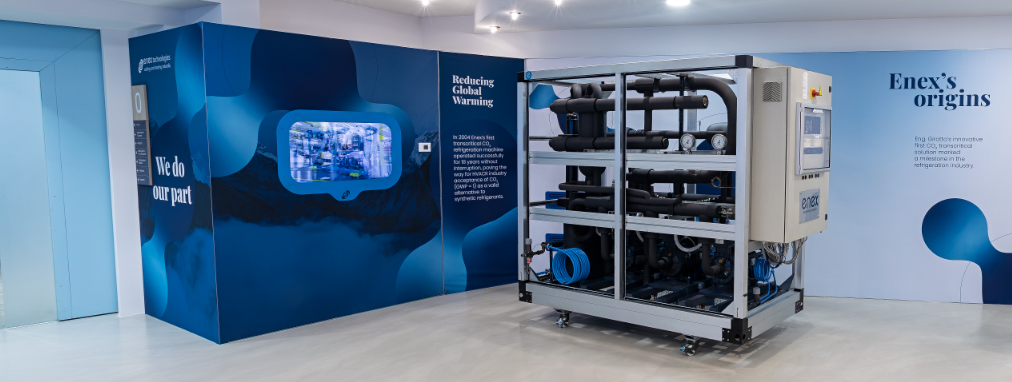
Even though in 1996 the only existing component was the compressor, we confirmed that using CO2 was not a problem of principle, but a technological issue of pressure containment and regulation. Once it was managed, the way to natural cold was finally open proving that high pressure was not a death sentence, but merely an engineering riddle.