







CO₂ Refrigeration System for Cruise Ship Applications

Enex Technologies & Clauger-Technofrigo srl
Bringing Natural Refrigeration Offshore: A Pioneering CO₂ Refrigeration System for Cruise Ship Applications
Executive Summary
The HVACR industry’s transition toward natural refrigerants is well underway across supermarkets, industrial facilities and commercial buildings. However, some of the most demanding refrigeration environments remain largely untouched by this transformation.
This project demonstrates that the future of sustainable refrigeration can extend far beyond land-based applications.
Through a strategic collaboration between Enex Technologies and Clauger-Technofrigo srl, a highly innovative CO₂ refrigeration system has been successfully designed and deployed aboard a modern cruise ship, overcoming the unique technical, operational and reliability challenges associated with marine environments.
The project combines Clauger’s globally recognised expertise in industrial refrigeration engineering and complex system integration with Enex Technologies’ leadership in advanced natural refrigerant technologies, creating an installation that establishes a new benchmark for sustainable marine refrigeration.
The Power of Partnership
Successfully implementing a transcritical CO₂ system on a cruise ship required the convergence of two complementary areas of expertise.
Enex Technologies brought decades of experience in natural refrigerants and transcritical CO₂ technologies, supported by a complete portfolio of climate-tech solutions for the full HVACR industry designed around CO₂, propane, ammonia and water. The company has developed numerous innovations aimed at improving the efficiency, reliability and scalability of natural refrigerant systems.
Clauger-Technofrigo S.r.l., part of the Clauger Group, a family-owned French company founded in 1971 and operating in more than 100 countries, brings over 50 years of experience in delivering complex industrial refrigeration projects worldwide. Backed by a network of 28 operational sites, we combine recognized expertise in industrial refrigeration, process air treatment and environmental solutions with end-to-end support across the entire value chain—from engineering and manufacturing to installation, commissioning and lifecycle services.
Both companies worked together on the critical task of adapting the system to the specific requirements of cruise ship operation. The result is a project that neither firm could have achieved alone: a fully integrated CO₂ refrigeration solution capable of delivering industrial-grade performance in one of the most challenging operating environments in the world.
The Challenge: Taking CO₂ Beyond the Shoreline
While transcritical CO₂ systems are now widely accepted in supermarkets and industrial facilities, marine applications present a completely different level of complexity.
A cruise ship refrigeration plant must operate continuously while travelling through different climate zones, including tropical regions where ambient conditions can significantly impact system pressures and performance.
Additional challenges include:
- Different onboard voltage and frequency requirements.
- Continuous operation with virtually zero tolerance for downtime.
- Service support across different oceans and time zones.
- Availability of spare parts during voyages.
- System stability during prolonged operation in highly variable environmental conditions.
This project set out to prove that natural refrigerants can address this issues while delivering reliability and offering significantly improved environmental performance.
The Technical Solution
At the heart of the installation is an advanced Enex Technologies Yukon transcritical CO₂ rack specifically engineered for marine operation.
The system delivers refrigeration at two different temperature levels:
| kW | Conditions | |
| Chilled & Freezer Circuit | 240 | -13 °C evap temp Dowcal200, inlet outlet temp -6°C, -10°C |
| 160 | -38 °C evap temp Hycool 45%, inlet outlet temp -29°C, -33°C |
The Yukon Rack is based on a 4+4 compressor arrangement featuring dedicated medium-temperature and low-temperature compression stages.
One compressor stage supplies the higher-temperature circuit, while the second stage serves the low-temperature freezing application.
The installation was engineered with high pressure-resistance levels across the main circuits, with design pressures of 60 bar on the low-pressure side 80 bar for the liquid receiver and 130 bar on the high-pressure side. This configuration was selected to maximise technical safety and help prevent safety valve intervention, even under demanding operating conditions. Particular attention was also given to environmental and onboard safety requirements in the electrical and insulation design, with halogen-free wiring and a suitably selected insulation layer.
Innovative Gravity-Fed Technology
One of the most innovative aspects of the project is the application of Enex Technologies’ proprietary gravity-fed CO₂ technology on the chilled circuit.
The Yukon rack incorporates a horizontal liquid receiver from which liquid CO₂ is distributed to two dedicated plate heat exchangers installed in parallel.
Rather than relying on mechanical circulation pumps, vapour generated inside the heat exchangers returns naturally to the liquid receiver through gravity circulation.
This design delivers several important advantages:
- Elimination of circulation pumps.
- Reduced system complexity.
- Increased reliability.
- Lower energy consumption.
- Improved thermal efficiency.
Most importantly, the design allows the CO₂ temperature profile to closely follow that of the secondary fluid. Compared with traditional solutions, this enables:
- Higher evaporation temperatures.
- No superheating requirement.
- Improved thermodynamic efficiency.
- Greater overall system performance.
Achieving stable natural circulation under marine operating conditions required exceptionally precise engineering and system balancing by both project partners.
Advanced Multi-Stage Architecture
The installation incorporates a sophisticated series of components designed to maximise efficiency, reliability and operational security.
Key system components include:
Compression Package
- Medium-temperature compressors.
- Low-temperature compressors.
Thermal Management
- Intermediate plate heat exchanger acting as an intercooler/desuperheater between the two compression stages.
- Regenerative plate heat exchanger to optimise cycle efficiency.
- Water-cooled condenser plate heat exchanger: The condenser utilises water at 36°C from the vessel’s technical loop.
- Post-gas-cooler subcooler: a dedicated subcooling stage using 6°C water from a separate onboard circuit. This design feature is fundamental to the project’s efficiency strategy. By lowering the overall inlet water temperature,the system can operate in subcritical mode whenever conditions allow, significantly reducing the compressor pressure ratio and improving thermodynamic performance.
The result is lower compressor energy demand, enhanced system efficiency and reduced operating costs. In an offshore environment, where operational efficiency is a key performance criterion, this solution represents an important contribution to the overall sustainability and effectiveness of the installation.
High Reliability for Offshore Operation
For refrigeration systems operating in the middle of the ocean, reliability is a mission-critical design principle. Unlike land-based installations, cruise ship refrigeration systems must maintain continuous operation regardless of location, climate conditions or immediate access to technical support. Even minor component failures can potentially result in costly downtime and operational disruptions.
To address these challenges, the Yukon CO₂ system was engineered with layers of redundancy and protection, ensuring maximum operational continuity under all conditions. The installation is also supplied with Lloyd’s certification for the vessel and heat exchangers, further strengthening confidence in the quality, robustness and compliance of its core components.
A key feature of the installation is the dual high-pressure control architecture. The electronic high-pressure valve is one of the most critical components in a transcritical CO₂ system, continuously regulating operating pressures and ensuring optimal system performance. In conventional configurations, a failure of this valve could compromise system operation and lead to significant downtime.
To eliminate this risk, Enex Technologies incorporated a parallel mechanical high-pressure valve, creating a redundant control strategy specifically designed for demanding offshore applications. Should the primary electronic valve experience a fault, the parallel mechanical valve can maintain system operation, safeguarding refrigeration continuity and significantly enhancing overall reliability.
This approach provides an additional level of security that is particularly valuable in marine environments, where immediate technical intervention may not always be available.
Together, these features create a highly resilient refrigeration platform capable of delivering stable, efficient and reliable performance throughout extended voyages across varying climate zones.
For Enex Technologies and Clauger, reliability was not treated as an accessory feature but as a fundamental design objective, ensuring that the environmental benefits of natural refrigerants can be delivered with the operational confidence required by the maritime industry.
Emergency Protection System
A particularly innovative feature is the dedicated R134a backup cooling unit connected directly to the liquid receiver.
Should an unexpected fault occur or electrical/network supply issues cause pressure to rise within the CO₂ circuit, the backup unit automatically cools the refrigerant contained in the receiver. By reducing both temperature and pressure, the system stabilises operation and provides valuable time for onboard personnel to intervene safely. This feature is especially important in marine applications, where immediate external technical assistance may not be available.
Environmental and Industry Impact
Beyond the technical achievement, this project represents a significant milestone in the decarbonisation of marine refrigeration.
By successfully adopting CO₂ as the primary refrigerant, the installation demonstrates that natural refrigerant technologies can provide a viable alternative to traditional synthetic refrigerants even in mission-critical offshore applications.
The project establishes a practical roadmap for shipbuilders, cruise operators and marine refrigeration specialists seeking to reduce environmental impact while maintaining the highest standards of operational reliability.
It proves that transcritical CO₂ technology is no longer limited to supermarkets, warehouses or industrial facilities, it is ready for some of the most demanding refrigeration applications in the world.
Why Is This Project Relevant?
This project is much more than a successful installation.
It represents:
- A breakthrough application of natural refrigerants in the maritime sector.
- A world-class collaboration between two refrigeration leaders.
- An innovative adaptation of transcritical CO₂ technology to offshore operation.
- A highly engineered solution balancing efficiency, sustainability and reliability.
- A replicable blueprint for the future of marine refrigeration.
By combining Clauger’s expertise in industrial refrigeration integration with Enex Technologies’ advanced CO₂ technology, this project demonstrates that sustainable refrigeration can operate wherever it is needed—even in the middle of the ocean.
For decades, natural refrigerants have transformed refrigeration on land. This project proves that the transition does not stop at the shoreline. Together, Enex Technologies and Clauger have demonstrated that CO₂ technology can successfully navigate one of the world’s most demanding environments, creating a new benchmark for sustainable marine refrigeration.
Simplified system diagram:
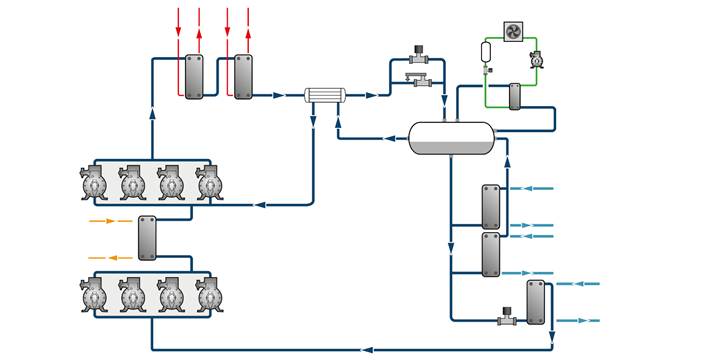
The most important components in the scheme are:
- Low-temperature compressors
- Intercooler plate heat exchanger
- Medium-temperature compressors
- Condenser plate heat exchanger
- Post-gas-cooler subcooler
- Regenerative plate heat exchanger
- High-pressure valve, with both electronic and mechanical redundancy
- Liquid receiver & associated back up cooling unit
- Evaporator plate heat exchanger (Dowcal 200E)
- Evaporator plate heat exchanger (Hycool 45%) with expansion valve