







Chapter 3: Ice, fire, and the birth of Enex
Sergio Girotto
You cannot leap over an abyss in a single bound; you must build a bridge. At the end of the 90s, the market was terrified of transcritical pressures, so we tamed the wild issue in stages.
To accelerate the project’s maturity, we introduced the first subcritical systems with CO2 as a refrigerant. The idea was to use CO2 only for low temperature (LT, evaporating from -35 to -40°C), while maintaining a conventional primary fluid for medium temperature brine chiller.
In 1997, we built the first one at a “Bingo” supermarket in Conegliano (Italy), nestled among the Prosecco hills, we installed the world’s first subcritical low-temperature system in cascade with an indirect system (R134a chiller).
Other installations followed, including one in the UK that used propane for the medium temperature chiller. It was a milestone that drew curious engineers from across Europe, but it was only a half-measure, the limitations emerged: the double circuit, circulation pumps and additional heat exchange reduced efficiency and increased complexity and cost. At the end, it was a compromise that solved only 30% of our environmental sin.
Then the first subcritical systems arrived in the retail sector as the spark for the introduction of CO2 cascade also in industrial refrigeration, using ammonia for the brine chiller, for example.
The true evolutionary leap happened in Lestans, a town near Pordenone in Italy in the year 2000. Here, we built the world’s first single-stage, entirely CO2-based transcritical system. We were like sailors without a compass, inventing a self-regulating mechanical system for the roaring pressure, designing (and self-producing) coaxial heat exchangers certified for the high pressure of 120-bar, and playing alchemist with lubricating oils in the trenches.
We were writing the rules of the game while we were playing. Then, came the baptism of fire and ice.
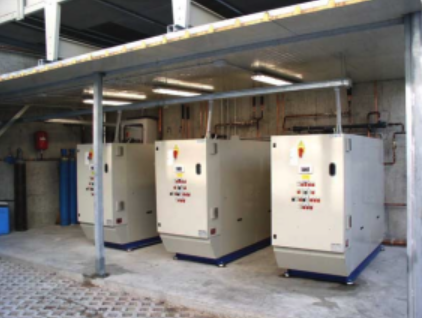
In 2002, we installed a massive outdoor plant in Treviso with three machines with parallel compressors, single-stage for MV and two-stage compressors. Radical innovation always invites the wrath of the elements, so, in the freezing winter of 2002-2003, with temperatures below 0°C during the night, we discovered that the CO2 in the stopped compressors condensed and separated from the oil. When restarting, since the oil was lighter than liquid CO2, the oil pump sucked in the natural refrigerant instead of the lubricant, destroying the compressors in a few minutes.
Then came the infernal summer of 2003, one of the hottest in history. The system held, but human frailty intervened. A maintenance error led to the opening of the safety valves at 160 bar. The roar of that mistake was so deafening that the poor, terrified neighbors called the Fire Department on us. And rightfully so.
The system survived, but we learned that this technology demanded a new aristocracy of technicians. The results of this installation were presented at the IIR conference in Washington in 2003, attracting the interest of many technicians, especially from Scandinavia.
Realizing that the rigid, slow-moving galleons of a large corporation could not navigate these wild narrow, new waters, I finally left my twenty-year career. Less than a year later, on March 1, 2004, Enex was born. A synthesis of Energy and Exergy (the part of energy that can really be used). The concept of Exergia, a pillar of the second law of thermodynamics, embodied our mission: the highest possible efficiency.
I had decided that we were going to be the first company in the world dedicated entirely to CO2.
Founding Enex was like starting to sail the open sea, between general skepticism and the titanic challenge of industrializing natural cold. Enex became fully operational at the end of 2004.